
No driveway? From 21st October, you're one step closer to charging at home
Excitingly, from 21st October 2026, households with on-street parking across England can fit a wallbox charger without a planning application.
There is a key condition to keep in mind, however. If your cable crosses the pavement, it has to run through a council approved cross-pavement channel such as Kerbo Charge.
Below is some more information on what exactly is changing, how cross-pavement charging works, as well as how to get started.
What’s changing?
Historically, a home charger on a house without a driveway typically fell outside of ‘permitted development’ rules. What this means exactly, is that both a planning application AND separate highway consent were required on the resident’s side.
As a result, this dual process was lengthy and required lots of paperwork, leaving many drivers understandably deterred.
The new rules change one key thing:
Wall chargers are now permitted development, including on front walls facing the pavement.
Cross-pavement channels no longer need planning permission, HOWEVER approval from your council is still required, as the pavement is public highway.
What is a cross-pavement channel?
A cross-pavement channel is a gully that is slotted into a shallow groove made in the pavement that runs from your property to the kerb.
When you charge your car, your cable sits safely inside the gully. Once you have finished charging, the cable is simply removed from the channel until you next need to charge your car.
The updated law describes it as a “pavement-embedded cable channel” that lets a charging cable cross the pavement safely. This wording is crucial, as the following methods of home charging do not qualify:
- Loose cables across the pavement
- Rubber cable mats or covers
- Overhead gantries or cable arms
The reasoning behind this is very simple, as our pavements must stay safe for all pedestrians. This includes wheelchair users, parents with prams, young children on scooters, and people with visual impairments.
Where Kerbo Charge comes in
Here at Kerbo Charge, we build cross-pavement channels for exactly this purpose.
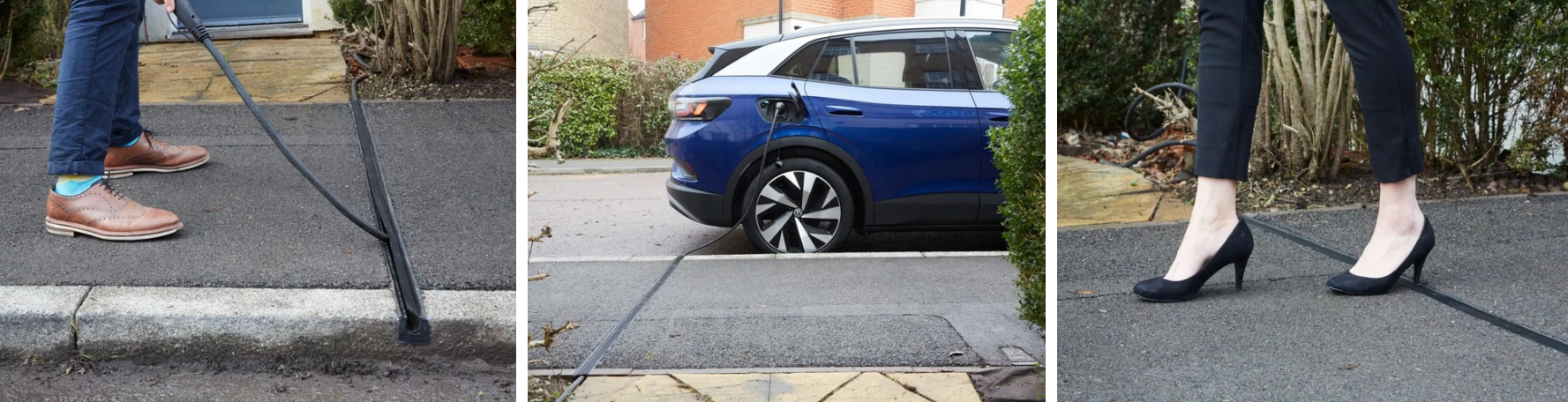
Insert and remove your cable in 30 seconds. The patented design opens and closes like a zip.
Our electric vehicle charging gully is designed to be discreet and blend in with the surrounding pavement.
The lid self-closes and can withstand 250 kN pressure, equivalent to an articulated lorry parked over the top on a single tyre.
Your council still has a say
Permitted development removes the need for a planning application, BUT crucially, it doesn’t remove the need for council approval.
The pavement is public highway, so nobody can dig into it without permission. The channel has to be installed by your highway authority, on its behalf, or with its authorisation.
Every council runs this a little differently. Some already have schemes up and running, some are still setting them up, and each one has its own application process. It works a lot like applying for a dropped kerb.
We work with councils across the country and can guide you through your local process step by step.
Is my street suitable?
Your council will check whether a channel can be installed safely outside your home. Things they’ll look at include:
- The width of the pavement
- Underground pipes, cables and inspection covers
- Street trees, grass verges and lamp posts
- Junctions and street furniture
- Whether the road is adopted (council maintained) or private
A channel doesn’t reserve the parking space outside your house. Anyone can still park there, so it works best on streets where you can usually park close to home.
The small print on chargers
The new rules come with a few conditions:
| Condition | What it means |
|---|---|
| One charger per property | Permitted development allows one outlet per house, or one per block of flats. Flat owners will need to agree it with their freeholder or managing agent. |
| Conservation areas | These are excluded, so you’ll still need planning permission. |
| Listed buildings and scheduled monuments | These are excluded and need the usual consents. |
| Wall clearance | Chargers on walls next to the pavement can’t stick out more than 20cm, and must leave at least 1.5m of clear pavement to the kerb. |
| Height | Chargers must be mounted no higher than 1.6m above the ground. |
Your charger also needs to be fitted by a qualified installer to current wiring regulations (BS 7671). Some councils ask to see the electrical certificate before you can use the channel.
Costs, grants and upkeep
If you don’t have off-street parking, the government’s EV chargepoint grant can cover 75% of the cost of your chargepoint and installation, up to £500. Conditions include a permanent cross-pavement solution like Kerbo Charge, council permission and an authorised installer. Check your eligibility before you install, as you usually can’t claim afterwards.
Depending on your area, these might include a site assessment fee, a licence or permit charge, and sometimes an annual fee.
Who owns and maintains the channel depends on your council’s scheme. You may be responsible for keeping it clear and reporting any damage.
If the channel is no longer needed, the law says it must be removed and the pavement put back as soon as reasonably practicable. Ask your council how this works in your area.
How to get started
- Check your property: look up whether you’re in a conservation area or a listed building, via your council’s website.
- Check your street: get in touch with the Kerbo Charge team and we’ll help you see if your street is suitable and whether your council is taking applications.
- Get council approval: we’ll guide you through your local application.
- Book your installer and check the grant: before any work starts.
- Get your Kerbo Charge fitted and start charging from home.
Ready to charge from home?
Check your postcodeEvery council runs its own process, so check with your local authority before going ahead. Grant details correct at the time of writing. Read the full legislation at legislation.gov.uk.
