
Pros & Cons of Charging an Electric Car at Home
EV home chargers are an overall plus, from cost saving and convenience to helping your home’s value. But it’s worth being aware of all aspects to help you make the most of charging an electric car at home.
In this guide we look at the pros and cons, as well as the cost of home charging and other common questions.
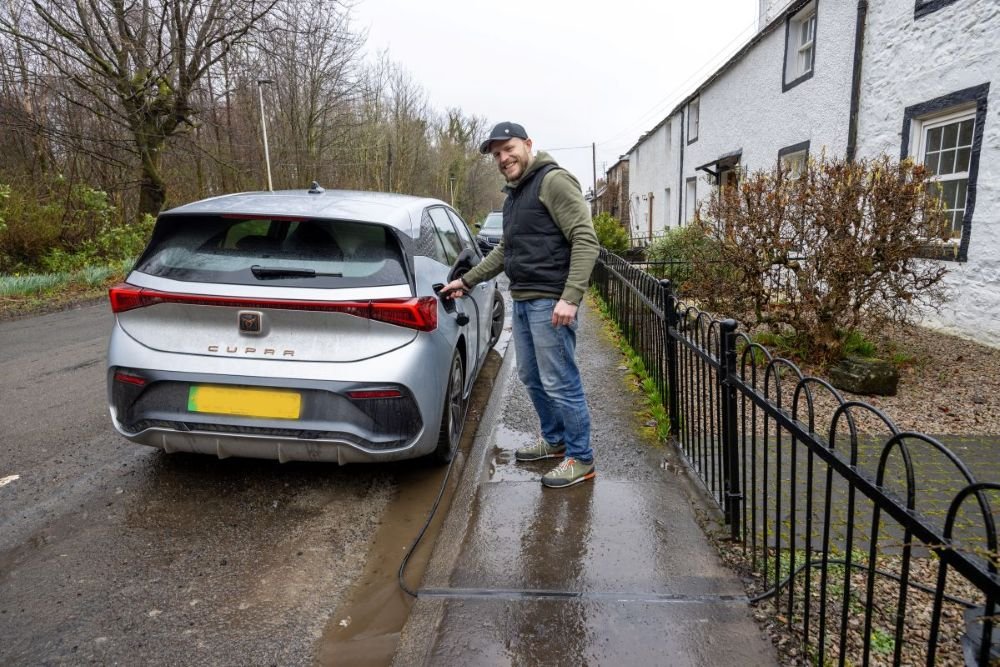
A Kerbo Charge customer in Stirling, Scotland
The benefits of charging an electric car at home
There are many benefits to charging your EV at home, from cost saving to ease of use.
Costs: with many energy providers offering peak time rates of roughly 30p per kWh, the potential savings are significant compared to public EV charging – which at the time of writing are 54p per kWh. And with pavement EV charging available through Kerbo Charge, you don’t need a driveway to benefit.
Off-peak perks: those savings are even greater under the off-peak rates offered by many providers. Usually offered overnight, these rates can be as little as 7p per kWh or less – meaning even more money saved.
Convenience: your car will generally spend more time at home than it will at work or out and about, so it’ll be much easier to keep the battery in the recommended 20-80% range.
Home value: having an EV charger installed at home can also help your house value, as it is a desired feature amid the growing popularity of electric cars.
The disadvantages of charging an electric car at home
Alternatives like public or at-work charging do have their advantages, but overall these are best balanced with home charging to get the most out of your EV.
Rapid charging: super-fast EV charging is available publicly, with speeds of up to 350kW and beyond (50 times faster than the average home charger), however these cost a lot more than home chargers and could decrease your batteries’ lifespan with frequent use.
Home charger installation: you may have to cover the cost of home charger installation, although this could be subsidised or even completely covered by a manufacturer offer or the government's chargepoint grant.
Higher energy costs: use of a home charger will increase your energy usage and therefore your utility costs. That said, this should be more than offset by the savings in fuelling a petrol or diesel car.
Charging an electric car at home
Below are our key considerations for charging your EV at home.
Parking position: position your electric car near your wallbox to avoid trailing cables, or use a pavement gully if on-street EV charging is your only option
Correct cable: ensure your cable has the correct power rating to get the most from your home charger. A 7kW charger, the most common speed, requires a 32-amp cable – while other cables are available, if the power rating is lower the charge times will be longer
Set a charge schedule: a number of energy providers offer off-peak electricity rates, typically through the night. Make the most of these by setting your EV to only charge during these times
Stick above 20% charge: just like your smartphone, an EV’s batteries could last longer if you stick above this range and avoid repeatedly draining to empty
On our EV charging advice hub, you can find more pointers on how to charge an electric car at home.
The cost of charging an EV at home
Whether you charge at home or in public, the cost depends on the EV’s battery capacity and the rate electricity is charged at. The calculation is:
Battery capacity (kWh) x electricity rate (£ per kWh) = cost of charging (£)
Now, applying that calculation to the entry-level Kia EV3, for example, and Ofgem’s energy price cap for 1 January-31 March 2026:
58kWh x £0.07p = £4.06 (figures rounded to the nearest pence)
Compared to an average cost of £68.17 for filling up a petrol or diesel car, based on average fuel rates at the time of writing and a 50-litre fuel tank, the savings are clear.
Factor in the additional cost of a wall charger if you want to consider the total cost of EV ownership. However, there are incentives available to reduce or even completely cut this cost, through the likes of a manufacturer offer or the government's chargepoint grant.
-
Yes, EVs can be charged overnight and for drivers charging at home, this might even be the best time.
Many energy providers offer off-peak rates at night, so the cost savings over running a petrol or diesel car will quickly stack up.
-
With a dual EV wallcharger, two electric cars can be charged simultaneously. However, as these typically cost more than a standard one-car wallcharger, make sure you have the need for simultaneous charging first.
For example, with EV ranges far exceeding the average daily commute, charging every day might not be required, so charging one car at a time would suffice.
-
At-home and at-work charging each have their own advantages, but for most motorists, home charging will be more beneficial.
While further cost savings can be had with subsidised EV charging at your workplace, this isn’t as convenient as being able to top up overnight at home – especially if you don’t work on site every day.
From guides to charging an EV on a terraced street to pairing your home charger with solar panels, we cover all manner of topics on our EV charging advice hub.
Use our postcode checker to find out if Kerbo Charge is available in your area.
