
How to Charge an Electric Car at Home: A Complete Guide
For the majority of UK motorists, charging an EV at home remains the most cost-effective method. And that’s unlikely to change any time soon, even if the government delivers on the rumoured tax cut for public charging.
But, despite the lure of electric cars, they still account for a small fraction of the UK car parc – so a lot of drivers might still be unaware of the ins and outs of charging an EV at home.
We outline the necessary steps and key considerations of at-home electric car charging here, or you can jump straight to the step-by-step process.
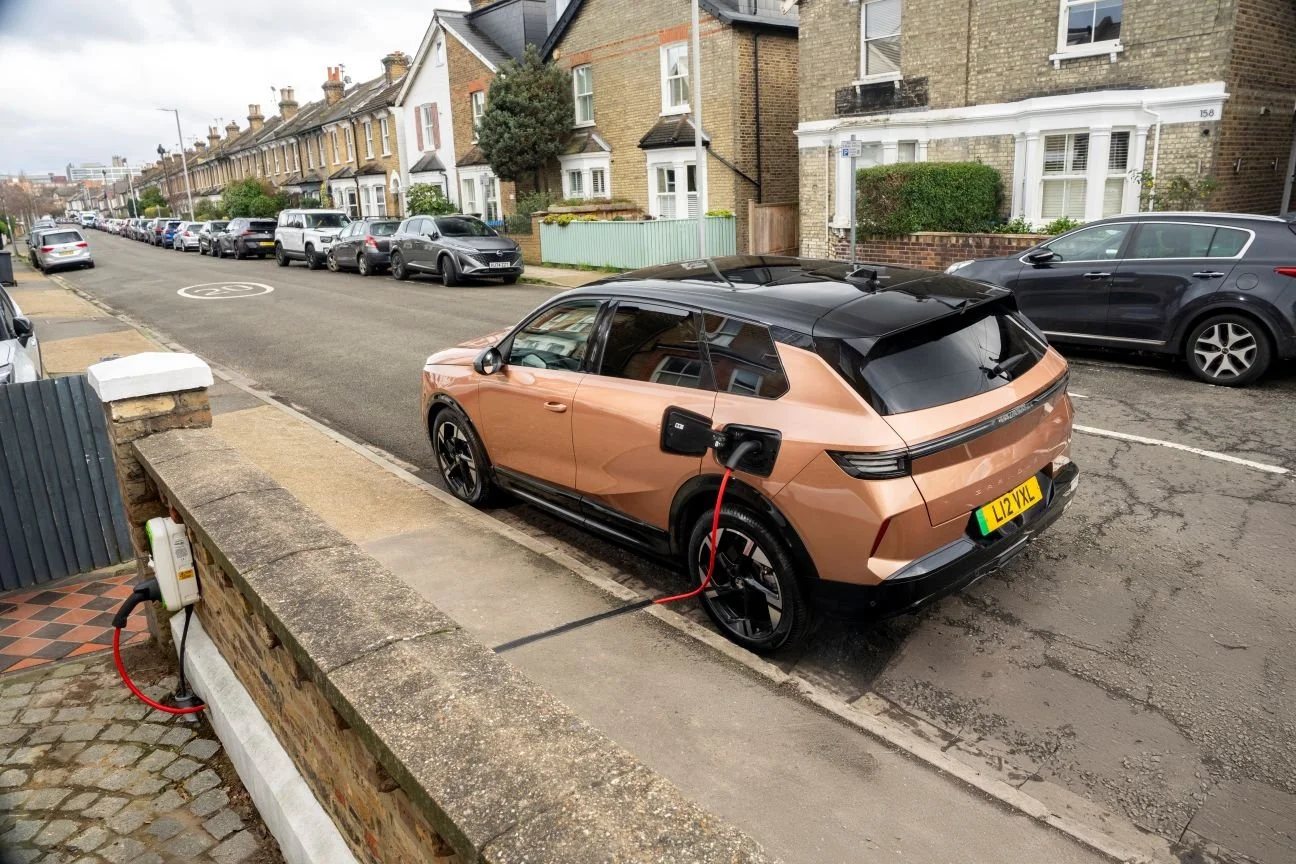
A Kerbo Charge installation in Kingston Upon Thames
What are the different types of EV charger?
EV chargers are often classified by the speed at which electricity is transferred. This speed is measured in kilowatts, shortened to kW. An EV’s battery capacity, on the other hand, is measured in kilowatt-hours (kWh).
In short, a higher kW figure means faster charge times and a higher kWh figure means an EV can store more electricity, and likely has a higher range.
While public chargers are capable of 350kW or more, below are the most common home charger speeds:
Three-pin socket (3kW)
Home EV charger (7kW)
Tethered vs. untethered chargers
Home chargers are also available tethered or untethered. With tethered EV chargers, the cable is permanently fixed for added convenience, but the wallbox is often bulkier as a result as the cable is wrapped around it when not in use. This is a downside if you prefer a subtle design.
On the other hand, untethered chargers (sometimes referred to as socketed chargers) don’t feature fixed cables. This means they’re more discreet as you can simply unplug the cable after use.
Because the cable isn’t fixed, however, an untethered charger will require you to keep a cable handy and plug in for each use. These often aren’t provided with untethered wallboxes.
Decide on the right EV charger type for you
EVs can actually be charged using a standard three-pin socket, but this isn’t the recommended method due to slow charge times and risk of overheating.
Although standard 13A sockets are capable of handling peak current loads of 13A for short periods if they are in good condition and well installed, they are not suitable to be used for continuous current loads above 10A for very long without becoming quite hot.
Common household appliances including high power electrical bar heaters, irons and kettles don’t draw peak 13A power for very long before their thermostat clicks off for a short period of time, which allows the cables and socket to cool down.
Sometimes there are underlying faults in an older socket or its wiring, such as dirty contacts or ring-main wiring terminals at the back of the socket that were not firmly-enough screwed down, or which have loosened over time thanks to vibrations in the building and temperature cycles over many years.
There’s also a risk of electric shock when two electrical installations are close to each other, but connected to different earth systems, and a dangerous voltage difference develops between the two. This is only safety mitigated if an Open PEN protection device is fitted by an electrician, plus if required an Earth Current Trip device (as set out in our electrical safety guide here). By time you’ve paid for all of that you may as well get a wall charger.
A wall charger is the most common at-home EV charger type, with much more reasonable charge times, ease of use. You may even be able to get a free or discounted wall charger, for example through your EV manufacturer or the government's chargepoint grant.
And with Kerbo Charge’s innovative on-street charging system, wall chargers aren’t just available to those with a driveway. Enter your postcode to find out if Kerbo Charge is available where you are.
EV charger installation requirements
Our key considerations for having an EV charger installed at home.
Permission:
Check you have permission to install a home charger – if you rent your home, for example, you may need your landlord’s say-so beforehand. If you have on-street parking then at the time of writing you need planning permission, however the government has announced this will be scrapped in Summer 2026.
Positioning:
Consider where your EV charger will be most practical, based on where you usually park your car at home. If a driveway isn’t available, Kerbo Charge’s on-street charging solution could be a great alternative.
Internet access:
EV chargers require an internet connection for features such as remote operation. While your home wifi may suffice, many chargers have 4G connectivity to protect against an inconsistent or weak wifi connection.
What time should I charge my car?
One of the biggest benefits to charging your EV at home is convenience – without the worry of long waits, unavailable or broken public chargers and expensive rates.
The time of day you choose to charge your electric car can also save you even more. Many energy providers offer off-peak rates, usually through the night, meaning money saved and a full charge by morning.
Overnight charging can usually be scheduled with an app or through the in-car settings, too, so there’s no need to be out in your slippers in the early hours to make the most of off-peak charging!
EV charging best practices
Plugging in at home is recommended over high-speed public charging for the majority of charges. This is because frequent fast charging may impact the batteries’ lifespan, as well as your wallet.
For example, according to Zapmap, the average cost of public EV charging in January 2026 was 54p per kWh for slow/fast chargers and 76p per kWh for rapid/ultra-rapid chargers.
However, with off-peak home charging rates available for 10p per kWh or less, you could save between 44p and 66p per kWh charging at home. Applied to an entry-level Kia EV3 with a 58kWh battery capacity, that’s a saving of between £25.52 and £38.28 for every full charge. Even if you charged just once a month, that’s an average of £382.80 saved per year over public charging.
We also recommend keeping the charge above 20% where possible, and not just to avoid being caught short on miles. Repeatedly draining to empty can also affect battery health – the same as your smartphone. If charging to 100%, avoid leaving your EV at full charge for several days as this can also harm battery health.
How to charge an electric car at home: step-by-step guide
Follow these quick steps to get the most from charging an EV at home.
Parking position: consider where your EV’s charge port is and try to position this near your wallbox to avoid trailing cables. If only pavement parking is available, Kerbo Charge’s on-street EV charging gully is great for hiding loose cables.
Correct cable: ensure your cable has the best power rating for at-home charging. If your wall charger operates at 7kW, the most common speed, you’ll need a 32-amp cable to fully benefit. Cheaper cables with a lower power rating are available but with longer charge times.
Set your charge schedule: to keep the cost down, use your EV’s app or in-car settings to schedule charging around off-peak times. Speak with your energy provider to see if this is something they offer.
Stay above 20% charge: where possible, try to keep your EV above 20% of charge to prolong the batteries’ lifespan. Dropping below this range is of course fine from time to time.
Find more advice on our EV charging advice hub, or use our postcode checker to see if Kerbo Charge is available in your area.
